2026/21 Financial/Tax Bulletin (January– February 2026)
We would like to share with you the latest developments in Turkish tax regulations and provide you an update on the regulatory changes along with their effects on your business through our tax bulletins. We summarized the important amendments and changes monthly basis, but this time we preferred for last 2 months of the year. Hope you enjoy reading!
Major Tax Issues
OECD releases a report about Tax Administrations for 58 countries.
- You can read the details by clicking the
- The Tax Administration Series (TAS) is a unique product containing a wealth of comparative data and other information on tax administration. It is intended to be used by tax officials to give them an understanding of the global trends in the design and administration of tax systems and to draw cross-border comparisons. While primarily aimed at analysts, it can also be a useful tool for senior tax administration managers or officials in ministries of finance when considering changes in tax system administration.
- The 2025 edition of the TAS takes a closer look at national-level tax administrations in 58 jurisdictions. While the publication traditionally put its emphasis on performance-related data and ratios for the latest available fiscal year, a key focus of this edition is a 10-year perspective on the evolution of tax administration and how the rise of artificial intelligence is shaping the future of tax administration.
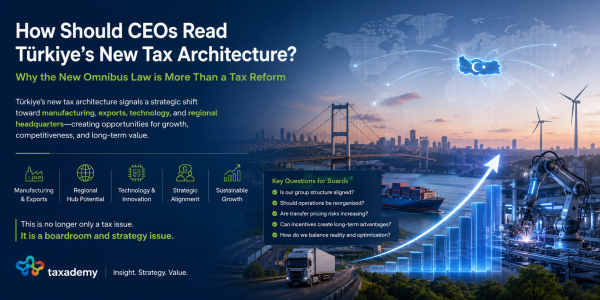
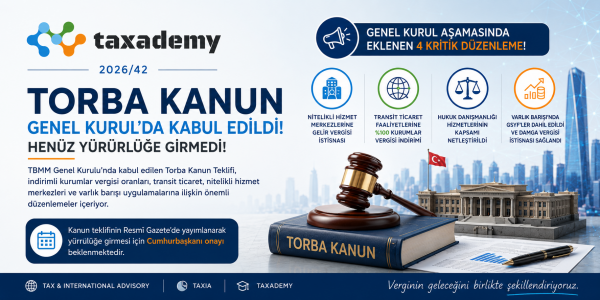
New Tax Omnibus is on Parliament’s agenda.
The main regulations in the law follow:
- A transaction tax of 0.03% (3 per ten thousand) will be levied on the transfer and sale of crypto assets (BSMV Law), according to the data, 4,2 billion TRY revenue is expected.
- Capital gains arising from the purchase, sale, and leasing income of crypto assets will be considered within the scope of income tax and will be subject to withholding tax (subject to 10% withholding tax; this tax will be the final tax except for fully taxable corporations and individuals earning commercial income),
- Gains from crypto assets obtained from platforms other than those subject to the Capital Markets Board (SPK) are subject to annual declaration as there is no withholding tax.
- Exemption from Value Added Tax (VAT) for transactions related to cryptocurrency (VAT Law),
- Exclusion of advertising and promotional expenses related to games of chance and betting as deductible expenses for corporate and income taxpayers in determining the tax base (Income Tax Law, Corporate Tax Law),
- Removal of corporate tax exemption for health institutions operating within foundation universities (Corporate Tax Law, Higher Education Law) (on the grounds of unfair competition),
- Inclusion of certain precious stones within the scope of special consumption tax (Special Consumption Tax Law),
- Application of VAT exemption to housing rentals included in the firms, as is the case for individuals (VAT Law) (due to sticky inflation in housing according to the Minister), (interestingly, this application was withdrawn by the Committee as the explanations were not satisfying)
- Conversion of some of the VAT exemptions into partial exemptions and narrowing of refund possibilities (VAT Law), (This new amendment is abandoned with a proposal in the Committee to review very carefully)
- Exemption from VAT for the transfer of real estate expropriated under Expropriation Law No. 2942 to the State and public legal entities (VAT Law),
- The clear regulation of the duties, powers, and responsibilities of the Chief Accountants, which were curtailed in the 2000s and weakened by being brought up as a reform agenda at that time, but whose rights have recently been restored.
- Granting the President the authority to increase or decrease the state contribution to the Unemployment Insurance Fund (Unemployment Insurance Law);
- The privatization of surplus real estate of public institutions by the Privatization Administration (Law No. 4706);
- Increasing the amount determined for paid military service by 25% (Military Recruitment Law);
- Excluding the portion of the daily meal allowance up to 300 TL from the base earnings for social security purposes and ensuring parallelism with tax legislation (Law No. 5510) (with this the exempted amounts will be the same for both tax and social security applications); (This article is slightly revised in the Committee. Annual adjustment of the figure will be renewed by the inflation rate and Social Security Administration does not have any power to increase or decrease the figure.)
- Providing a discount on the debt amount for housing and workplaces built after the earthquakes that occurred on February 6, 2023, upon request by the beneficiaries, on the condition that the debt is paid in full by December 31, 2026 (74% discount for first homes, 48% discount for first workplaces). that is intended.
- The Law has been accepted after heavy discussion in the Budget Committee. Some of the articles have been removed after reviews and some are added.
- Free zone corporate tax exemption is rewritten. Originally, the firms in free zones were not subject to corporate tax for the exports from free zones to abroad. It is subject to tax if it is sold to Türkiye. With the new changes the inter zone transactions and sales to other free zones will be exempted from corporate tax regime in Türkiye.
Türkiye has switched to the pricing setting mechanism for the fuel / gasoline.
- Turkey has switched to the eşel mobile system at fuel prices. In the Eşel mobile system, if the fuel cost increases, there will be a 75 percent discount on excise duty.
- The sliding scale system is a tax adjustment mechanism to prevent the reflection of increases in oil prices or exchange rates on consumers.
The digital services tax rate is being gradually reduced.
- According to the decree approved by the President, the tax will be applied at 5% for 2026 and 2.5% for 2027. The President may reduce this tax rate to as low as 1%.
Tax Authority announced a new Communiqué regarding with the “tax compliance report” system.
- With the new regulation, the taxpayers enjoying many of the tax incentives or exemptions should get a “tax compliance services” from sworn-in CPA firms.
- Top up tax, tax incentives for R&D centers, tax exemptions for technopark firms and free-zone firms are some of the defined company types to get this service.
- It is a necessity for the FY25 and upcoming years.
- In some cases, the same items are also applicable for income tax purposes. There are some thresholds for tax certification on those exemptions between 200.000, 500.000 to 1 million TRY. (roughly USD5K to 25k)
- Emission Premium Earnings Exemption
- Technopark, R&D and Design Center Tax Credit System
- Interest Deduction Arising from Cash Capital Increase (Notional Deduction)
- Foreign Subsidiary Earnings Exemption
- Foreign Subsidiary Share Sale Gains Exemption
- Real Estate Investment Funds or Partnerships Earnings Exemption
- Free Zones Exemption in Corporate Tax
- Exemption Software, Engineering, Training and Healthcare Services Provided Abroad
- Foreign Construction, Repair, Assembly and Technical Services Earnings Exemption
- Patent Box Regime
- International Shipping Profit Exemption
- Pillar II Top Up Tax Calculation
- You can read more details by clicking the Taxademy blog on the issue.
The interest rate on the 2025 cash capital discount is revised as 45.34%.
- New capital injection will enjoy this “notional deduction” depending on the capital’s origin.
- The notional interest deduction was limited to 5 years with an amendment in 2022. There was no time limit before this change.
- Foreign capital will be deducted at a rate of 75%. Domestic capital will be deducted at a rate of 50%. There are different rates from 0% to 100% in this incentive application.
Tax declaration deadlines are approaching for income and corporate tax in Türkiye.
- Income tax returns for FY2025 should be filed in March.
- Real person taxpayers who are subject to income tax should file their returns electronically by the end of March 2026. (Tuesday March 31st)
- You can click the brochure to prepared by Turkish Tax Authority in English.
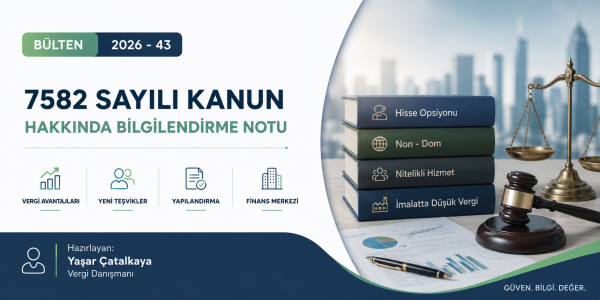
New Tax Omnibus has been enacted and started to be implemented.
- Consisting of 36 articles, new Law includes narrowing the current tax exemptions for taxpayers and increasing the social security burdens for the firms.
Tax-free Foundations (NGO) are to submit “Exemption Reports” in March
- There are more than 300 Foundations in Türkiye to enjoy tax exemption. They must submit a special exemption report certifying certain conditions by a sworn-in CPA.
- Firms can deduct donations / aids to those NGO’s in their corporate tax returns as well.
Numerous double taxation agreements (DTAs) and mutual investment promotion agreements are on the Turkish Grand National Assembly's (TBMM) agenda.
- Those are Azerbaijan, Gabon, Cuba, Burundi and Palestine. We see that the Multilateral Agreement (MLI) has not been submitted to Parliament again.
- The Treaty Agreement between Türkiye and Hong Kong for the Avoidance of Double Taxation has been enacted into law. The law was discussed and accepted in the General Assembly and subsequently published in the Official Gazette.
New social security incentive for employees has been published. It is 1.270 TRY per employee.
Banking & Finance
OECD released the Global Debt Report
- Global debt markets are navigating a difficult terrain. Geopolitical tensions, trade disputes, and an uncertain macroeconomic environment are adding pressure to already stretched markets. But debt markets have been resilient so far. This stability, however, masks deeper structural developments. The cost of long-term borrowing has risen, and the resulting shift in issuance towards shorter maturities increases refinancing risks. The growing role of more price-sensitive investors may also make debt markets more vulnerable to shocks. Their future resilience is therefore not guaranteed. This is particularly important as the scaling of AI and growing defense spending are expected to further increase borrowing from the markets.
- These challenges must be carefully managed to ensure that sovereign and corporate bond markets, with a combined size of USD 109 trillion, continue to provide stable financing to governments and corporations. The 2026 Global Debt Report aims to support efforts to sustain the resilience of debt markets. Global Debt Report 2026 | OECD
Thresholds are increased for the e-money and payment companies by CBRT.
The Banking Regulation and Supervision Agency (BRSA) have revised credit card limits.
- According to December 2025 data, there are approximately 13.3 trillion TL in individual credit card limits in the sector, with only 21% (2.8 trillion TL) of the total limit being used, while 79% remains unused.
BRSA (BDDK) has updated the limits and rates for housing loans.
- For some time now, the BDDK has been determining the upper limit for housing loans based on value and energy class. The limits range from 5-20 million TL, and loan rates vary between 20% and 90% depending on the energy class.
Central Bank of Republic of Turkey reduced the interest rates as expected.
- The Monetary Policy Committee (the Committee) has decided to reduce the policy rate (the one-week repo auction rate) from 38 percent to 37 percent. The Committee has also lowered the Central Bank overnight lending rate from 41 percent to 40 percent and the overnight borrowing rate from 36,5 percent to 35.5 percent.
The Central Bank of Turkey (TCMB) has revised the rediscount and advance interest rates.
Commercial Regulations
The Competition Board has updated the Communiqué on Mergers and Acquisitions.
- Communiqué No. 2026/2 amends Communiqué No. 2010/4, which originally regulated this issue. Numerical thresholds have been updated, a lower threshold has been set for technology undertakings, and the annexed Notification form has been revised. Furthermore, the definitions of undertakings, transaction parties, and technology undertakings have been updated, and Article 13 has been rewritten.
Exporters’ obligation to sell the export income to CBRT ends in April.
- The foreign exchange conversion support (3%) and export foreign exchange sales obligation (35%) are current until the end of April 2026.
R&D and Incentives
Manufacture Industry Financing and Employment Protection Support Program will start
- To ensure production continuity in the manufacturing industry, facilitate access to financing for businesses, and contribute to the preservation of existing employment, the Credit Financing and Employment Protection Program for the Manufacturing Industry will be implemented.
- The program will be implemented in collaboration with the Ministry of Industry and Technology, the Ministry of Labor and Social Security, KOSGEB, and the Turkish Employment Agency. SMEs and large-scale businesses operating in the manufacturing sector will be eligible to benefit from the program.
The lower limit for the mandatory 3% R&D fund allocation has been increased.
- The amount, which was applied as 2 million TL in income and corporate tax returns for the years 2023 and 2024, has been increased to 5 million TL for income and corporate tax returns for 2025, in accordance with the relevant Presidential Decree.
- The upper limit of 100 million TL remains unchanged.
- Don't forget your obligation to allocate 3% of your funds to R&D and Technology Parks.
The product lists subject to the Priority Product List Regulation have been updated.
The list of local investment areas has been renewed.
Amendments have been made to the Decision regarding e-export support.
- The support rate for e-export promotion projects has been reduced from 75% to 50%; 'Marketplace commission expense support' and 'E-export promotion project support' have been included among the supports for which additional target country points will not be applied; and it has been stipulated that the amount of support to be paid under the Decision cannot exceed 75% of the expenses subject to support.
Customs & Foreign Trade
Inward processing regime is extended till the end of 2030.
- Processing transactions under the Inward Processing Authorization Certificate (DIIB) without collecting VAT, within the scope of the deferral-cancellation application, for the delivery of raw and auxiliary materials within the country to taxpayers holding the certificate, has been extended until December 31, 2030, to be applied from January 1, 2026.
The list of countries from which export proceeds are not required to be repatriated has been updated.
- Mozambique and Burkina Faso have been added to the list, which previously included 34 countries.
Türkiye and Hong Kong Mutual Promotion and Protection of Investments Agreement ratified.
- “The ratification of the Agreement between the Government of the Republic of Türkiye and the Government of the Hong Kong Special Administrative Region of the People's Republic of China on the Mutual Promotion and Protection of Investments is deemed appropriate.”
Türkiye has begun preparations to lead the COP31 summit.
Foreign exchange support program is getting limited to the scope and the Tax Certificate.
- The Central Bank of Turkey (TCMB) is implementing a limited program for foreign exchange conversion support through “tax exemption certificate” (VRHIB.)
Miscellaneous
The Public Oversight Board (KGK) has redefined the limits for Sustainability Reporting.
- The Board had previously determined the financial institutions subject to mandatory audits under TSRS (Turkish Sustainability Reporting Standards) and the threshold values.
- Firms meeting these criteria will be required to submit the report if they meet at least two of the following criteria for two consecutive periods: assets, turnover, and employees.
- The thresholds are defined as 1 billion TL in assets, 2 billion TL in turnover, and 500 employees. It should also be noted that these limits cover audits for the year 2025.
The application of statutory interest for delays according to the Customs Law is unconstitutional.
- According to the Supreme Court decision, the provision regarding this practice has been found unconstitutional and annulled. The annulment decision will come into effect after 9 months.
Hope to see you in 2 months with new Tax Newsletter in English.
Best regards,
Taxademy Partners
PDF İndir