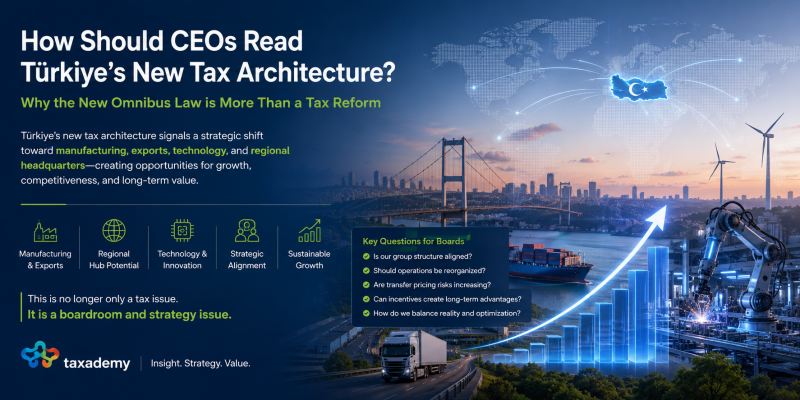
How Should CEOs Read Türkiye’s New Tax Architecture? Why the New Omnibus Law is More Than a Tax Reform
Executive Summary
The recently adopted Omnibus Law in Türkiye should not be viewed merely as a technical tax reform. The new framework signals a broader economic repositioning strategy centered on manufacturing, exports, technology, and regional headquarters. We follow the updates for our readers very close;
Corporate tax differentiation favoring manufacturing and export-oriented activities may directly influence corporate structures, investment decisions, supply chain models, and group company architectures including the region for multinational chains and investors.
This is no longer only a tax department issue. CEOs and boards are entering a period where tax policies must be evaluated as strategic competitive instruments. You can see Minister Simsek’s presentantion in London.
A New Economic Message from Türkiye
The latest legislative changes adopted by the Turkish Parliament reflect more than a fiscal adjustment. They reveal the government’s intention to reshape Türkiye’s role within global supply chains and regional production networks.
Particularly notable was the discussion around preferential corporate tax treatment for manufacturing activities and export-oriented operations. In parallel, incentives for qualified service centers and industrial zones demonstrate a growing emphasis on value-added production, technology ecosystems, and regional competitiveness. Türkiye is repositioning its situation in this new world after geopolitical turbulence.
At a time when global companies are rethinking production geography, nearshoring, and supply chain resilience, Türkiye appears to be positioning itself as a strategic manufacturing and logistics hub. There are many reasons including tax / fiscal benefits nowadays.
Why Boards Should Pay Attention
For many years, tax discussions remained largely within finance or compliance departments. That era is ending. It is not pure tax rates but more high-level strategic decision.
The new tax architecture may directly affect:
- Corporate group structures
- Manufacturing vs. trading models
- Investment locations
- Transfer pricing frameworks
- Supply chain organization
- Regional headquarters planning
- Operational segmentation strategies
As a result, tax policy is becoming a boardroom issue. We are here to answer your questions.
Forward-looking companies will increasingly evaluate whether their current operational architecture aligns with the incentives and risks emerging under the new framework.
Key Questions for CEOs and Boards
Management teams may soon need to address questions such as:
- Is our group structure aligned with the evolving tax environment?
- Should manufacturing and trading operations be reorganized?
- Does our supply chain require redesign?
- Are transfer pricing risks increasing?
- Should Türkiye become a regional production or coordination hub?
- Can industrial zones or qualified service center incentives create long-term advantages?
- How should operational reality and tax optimization be balanced sustainably?
The discussion is no longer about tax rates alone; it is about how companies redesign themselves for the next competitive era, especially regarding climate transformation and green programs.
Strategic Opportunities and Risks
The emerging framework may create important opportunities for companies focused on:
- Manufacturing
- Export-driven growth
- Technology production
- Regional coordination structures
- High-value service operations
However, artificial restructurings designed solely for tax & incentive optimization could create significant future risks related to transfer pricing, substance requirements, and regulatory scrutiny.
Sustainable alignment between operational reality and tax planning will therefore become increasingly important.
Türkiye’s Next Competitive Chapter
Türkiye’s evolving tax policy appears closely linked to a broader ambition: strengthening the country’s position in global production and investment networks.
Yet tax incentives alone will not determine success.
Investor confidence, predictability, access to finance, legal certainty, institutional stability, and long-term economic vision will remain equally critical.
Companies in the coming years may compete not only through products and pricing, but also through organizational design and strategic positioning.
The new tax architecture could become one of the defining factors shaping that competition.
Şaban Küçük
Tax & International Advisory | Taxia & Taxademy
www.taxia.com.tr / tax@taxia.com.tr
PDF İndir